Why Power and Dominance Have no Place in Peaceful Relationships
Podcast: Download
Subscribe: Apple Podcasts | RSS
PHIL: I have been writing for myself about how the two grand emotions of love and fear influence the structure of society and how power fits in, and it reminded me that power is never a problem in our relationship. Over the years, I have occasionally wondered if there is a power dynamic that I was not seeing, so I would look for signs of it, but I could never see one. It might be useful to talk about that lack.
The starting point is that we are both on the same side. This fits in with my political thinking that we are all individuals, but also social creatures that need each other to survive. Our individualism can lead us in different directions, but ultimately we have to coexist with others.
So with Maude and me, our individualism is allowed full rein because we know that it is not a threat to the connection between us; that we are on the same side. And what would different sides involve? Being right; eating the last cookie. I think it all boils down to the challenge of staying alive in the world. Pardon me if I take a high-level view of 4 billion years of life; I like looking for general principles.
Of course there are differences between us, but they never descend into acrimony. Let me explain. Say that I want one thing, and Maude wants another. Sometimes it is obvious that one of us has a much stronger desire for their choice than the other person; say 5 as opposed to 2 (if you don’t mind my quantifying the level of desire). If I’m the 2, I’m happy to defer because I don’t have that much attachment to my choice (see Buddha for details). I get pleasure from seeing Maude happy, and I know that in the long term, there is a balance between us. Like a tree swaying in the wind, sometimes it leans one way or the other, but ultimately it grows straight up.
This may sound suspiciously like compromise to you, but it isn’t, because there is no feeling of giving something up. It never feels like we are two individuals fighting over the spoils, because the sense of being on the same side prevails.
When we both have a strong desire, what happens is that each of us hears what is important for the other, and we can change what we want in a way that might work for the other person. As each of us continues to do this, we eventually find a place of agreement. There has been no compromise. It is a magical way of finding a solution. The more we have done this, the more we know that eventually we will reach agreement, which makes it easier – even pleasurable – to engage each other this way. We have each retained our own power.
MAUDE: Phil was sharing some thoughts he’s been having about power, and it turned into discussing power and dominance within relationships. He remarked that it doesn’t seem to ever be a part of our interactions, and soon we were into talking about this as a post topic. Surprise!
In our writings about peaceful relationships, we write from our own personal experiences. I realize that in all my deep relationships, there are no issues of power or dominance; no attempts of one person trying to lord it over the other, or to control what happens. And yet, it is something that many of you will recognize as having been a part of relationships you’ve had.
When one person attempts to assert themselves over the other, there is a separation between the two by the very nature of that act. It is no longer about relating. When someone acts in this manner, they are not really into a relationship because they are not coming from the desire to connect. They are stepping outside that connection to try to impose something upon the other person. Instead of the unifying quality which characterizes peaceful encounters, there is judging, estrangement, and measuring; there is force being applied rather than respect and acknowledgment. Need and lack of self-esteem drive such a person to have to always be right, and to push the other person to see, act, and agree with their way.
In balanced, loving relationships, each person encourages the other to be their very best self and to share that self fully. There is joy and celebration in the free expression of each person’s uniqueness, while at the same time building a sense of kinship and oneness that is the relationship itself. There is a give and take and a seeking of mutual solutions that give both parties what they need.
Listening and wanting to understand what the other person feels and thinks are driving forces within peaceful connections. There may be happenings in life that make one or the other unavailable for this kind of relating for a period of time. Health challenges are a good example of something that can cause a passing, less attentive presence. Yet this is not a characteristic of such relationships. A flowing give-and-take, rather than one of the parties pressing for dominance, is such a characteristic.
So, when it is your intention to build peace within your interactions, beware of pressure and attempts at power being applied by anyone. I have never found this produces anything of value. What’s your experience, and how have you dealt with it?
Photo credit: Maude Mayes
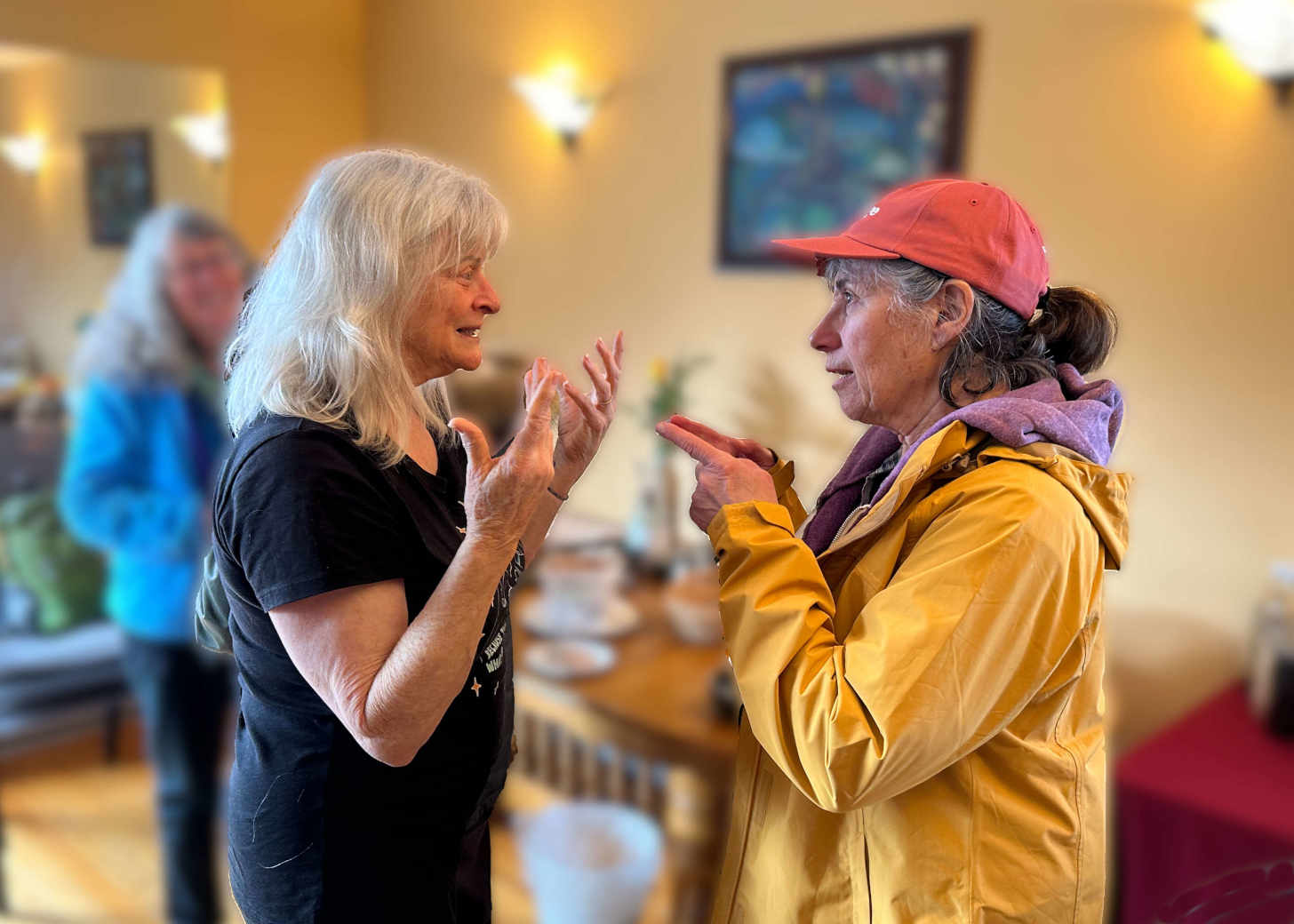
Photo note: What’s happening here?
Read what else we have written on this topic.
Get our free weekly newsletter about how to have a harmonious relationship.