How to Grow Trust in Your Relationships
Podcast: Download
Subscribe: Apple Podcasts | RSS
PHIL: When you sit down on a chair, you trust that it won’t collapse under you. When you go to a supermarket, you trust it will have bread. Trust consists in knowing how these things behave; your expectations are met; there are no surprises; you feel safe.
Society is built on trust: you trust that everybody will drive on the same side of the street; that someone will pay you after you have done work for them; that the food you buy is not contaminated; that a rental agreement prevents summary eviction.
Likewise, when it comes to people, trust consists of knowing how they behave. Even if they have some weird quirks, you can trust in that behavior.
It takes time to observe someone in various circumstances to establish a level of trust: how do they handle pain, rude people, money, changes in plans?. For Maude and me, trust developed quite rapidly, and I think one reason is that trust is a feeling about the other person as much as an assessment of their behaviors.
An important part of trust is consistency: that the same person shows up each time. I’ve been in relationships with a Jekyll-and-Hyde quality: an entirely different crazy person suddenly shows up and pulls over a bookcase or throws the main breaker in their anger. With Maude, that is who I get, every time.
So I think that to create trust, you have to turn up as the same person each time. Obviously, you’re going to have different moods like playful, sad, distracted, political, or serious. I think the schisms I’ve seen come from holding two different views that are irreconcilable, like the need for connection and a fear of smothering or abuse or some other earlier trauma.
To avoid this, you have to know who you are. You have to recognize all those facets within yourself, so you are not trapped in any one of them. It’s a lifetime process of introspection and learning from your mistakes.
You find yourself in your body. This is hard (for me, at least) because words and explanations and reasons are so seductive. Being present is another way to describe this. It’s paying attention to everything that is going on inside yourself, with the other person, and with the whole environment.
To turn up is to be in touch with what you feel and be open to sharing it, to exposing who you are. There’s a risk in doing that, and it might not always work, but it’s necessary to create real connections with people.
It comes down to having a place within yourself that is solid and that you can trust, just like the chair I described in the beginning. I’m not always successful at finding and staying in that place; it’s a work in progress.
MAUDE: Trust is such a funny thing in so many ways. You trust that the sun will rise and set every day. You trust that when you awaken from sleep you will be in the same place you were when you went to bed. You trust that most things will continue to be the same as they always were. We trust what we have learned throughout our lives to count on.
Trusting people is similar. This kind of trust consists in knowing how a person behaves. That takes time to learn through interaction and observation. You receive the information both verbally and non-verbally. It is often not something you think, but rather something you feel.
Trust is basic for the deepening of a relationship. Many look outward toward the other person and whether or not they can be trusted. This is an important consideration, but I’d like to suggest that trust, like so many other vital elements of connections, must start within you.
Trusting yourself allows you to learn what trust is, and to know what you are looking for when evaluating trustworthiness. It rapidly becomes clear when questioning your own trustworthiness that you have to know yourself to find the answer. The more you know what is of meaning and value to you, the easier it will be to establish trust within your relationships. You will be looking for what is true and important for you in the interactions, and not something superimposed upon you from your culture and upbringing.
To create exchanges of trust involves being able to show up each time and be yourself; the same self you shared the last time you interacted with that person. Both Phil and I have been in relationships where we were never quite sure who would show up, as there was so much change from one encounter to another. You can learn to evaluate what is causing some of this behavior, but regardless of the why, it leads to tension and a lack of relaxation that is not conducive to peaceful relationships.
For calm and peace within your deep exchanges, it is necessary to be present and offer the fullness of who you are openly and without defense. This requires that you know what you feel and are willing to take the risk of exposing who you are to the other person. Once you can bring yourself to the table in this way, you no longer need to expend effort hiding yourself, and you will be available for hearing, seeing, and feeling who the other is. This generates openness in return, and a feedback loop of a sort is created. The more you trust, the more trust grows.
Photo credit: Jane Jacobs
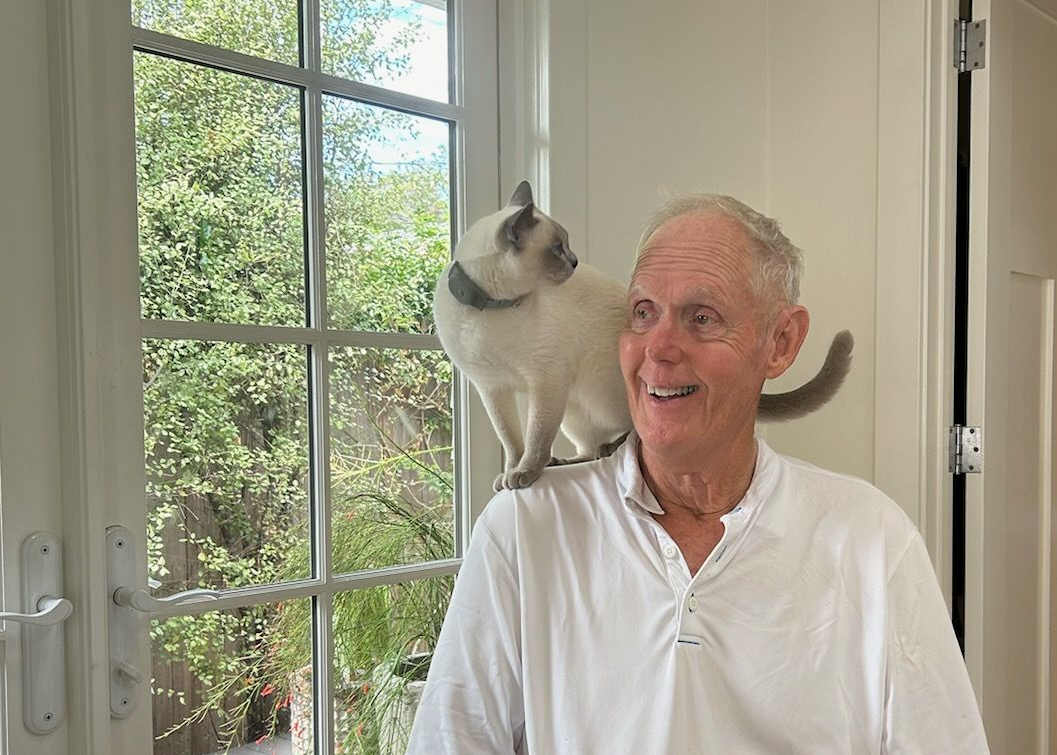
Photo note: Grizz and his cat
Read what else we have written on this topic.
Get our free weekly newsletter about how to have a harmonious relationship.