What’s in the Cards for Your Relationship?
Podcast: Download
Subscribe: Apple Podcasts | RSS
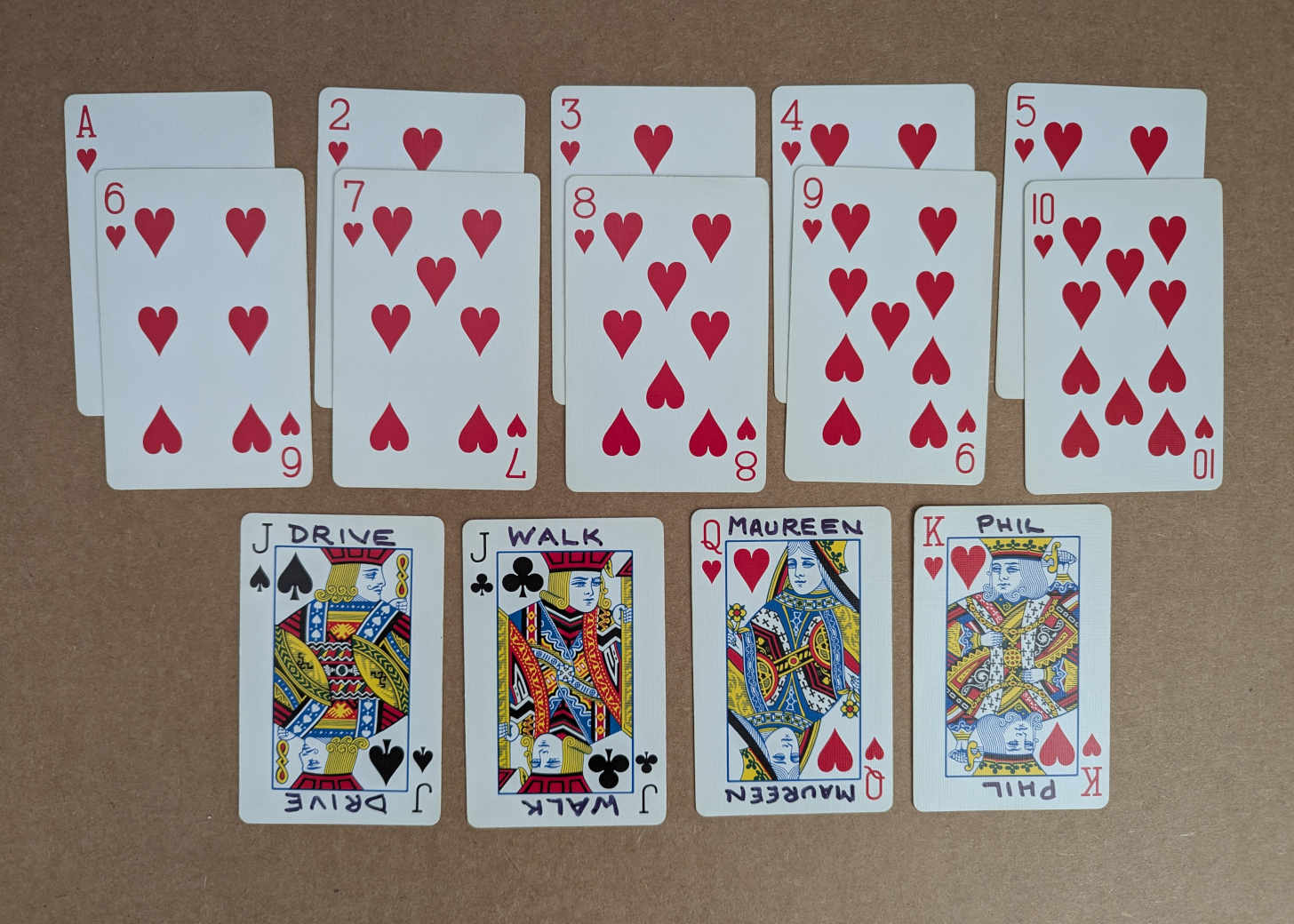
PHIL: You talked at lunch about two friends who spend much of their day in each other’s company doing activities together, and I said that is not us; we have a different balance, though I suspect it’s not totally equal, and that you would prefer more together time. You said yes, but not in a complaining sense; that you would like different activities, and you shared a number of things we used to do that you would like to add back to our time together. Afterwards, I had the idea of making a game with an old deck of cards to choose a day and what we might do with it. Ace through ten for the mornings and afternoons of the week, and court cards marked Walk, Drive, Phil, Maude for what we might do. I had you pick a card from each deck, and as a result, we’re off for a drive soon.
The point here is that in a conversation like this, we listen to each other and wonder how the experience is for the other person, and if there is a mismatch, my inclination is to say, hey, how’s that for you? What’s going on here? Uh, what do you think? I am more likely to look at what the resistance in me is about than I am to push back. There is a fluidity with which we interact and flow, and the end result is not compromise; it’s a lack of attachment to a particular way.
This is something that we are always able to do, and we’ve described it as being on the same side, but that doesn’t quite capture it, because that brings up an image of us side by side in folding chairs, facing the same direction and watching a parade (of which there are several in town). The sense is more of a connection to us, a reality that is the same for you and me. It’s a sense of something larger than myself, and we both know, in some mysterious way, that the other knows it too. It has a solidity to it that comes from the fact that, at some point, we decided we were all in.
If that’s a bit woo-woo, sorry about that, but I can’t find any better way to describe it. You have to believe it exists, and want something like we’re describing, and be able to look for it. I think you need all three of those factors.
It takes a certain amount of intention. You have to never be anything but yourself. If you don’t want conflict, don’t create conflict. Even though it might appear inevitable, it isn’t. Instead, lean into the relationship.
MAUDE: Phil and I had an experience recently that I feel is worthy of sharing here. It is such a good example of how a peaceful relationship can work. I have been feeling lately that our time together has fallen a bit into a pattern of specific activities, all wonderful, but nevertheless limited. We shut down devices and outside interactions at around 8:30 every evening and spend the rest of our waking time with just the two of us: sharing, playing, doing crosswords, talking, and watching programs.
The other day, I was describing to Phil that a couple we know spend almost all their time together, and although this is very different from what we do, they are also very happy, and still have active, separate inner lives. Phil remarked that we have a good balance between time together and time apart, but that he felt that maybe I wasn’t quite satisfied and wanted more time together.
This could have been the start of an uncomfortable conversation in some relationships. It could have created tension or discord. One person professes they want something different than what is happening, and the other feels pushed or pressed or put down. Not so for us. We both listened carefully to each other, and there was a pleasant, relaxed atmosphere between us. It was clear that each of us wanted to know how the other felt, and there was no fear of upset, withdrawal, or pressure to be otherwise.
I shared that I was missing some of the activities that we used to do in the past. We seem to have gotten so busy with life that some of those things we really enjoy, especially our forays into nature of various kinds, have fallen away. All through this discussion, I could feel Phil’s deep attention, and it was attention without any charge. We were together talking about our interactions and both looking for paths forward from there.
When there is a difference in how we see things, we both tend to look inward to find out how we are feeling and what we can learn from that. We do this with curiosity and the desire to grow. When you are assured of being listened to, and you know that there is no opposition to one another and to what you share (a different way of saying you know you are always on the same side), you can speak freely and personally without any need to protect or defend.
We used to refer to our relationship as being one with no thumbtacks on the dance floor. Therefore, we can both leap and prance without ever coming down on a thumbtack, not even one!
I have this kind of freedom and assurance in all my deeper relationships. These are relationships where both parties are not looking for or creating drama or conflict. Differences of viewpoint are not points for disturbance or arguing; they are opportunities to learn more about how something can be viewed.
How does one get there? You have to believe there is such a way of being with one another, and choose with the intention to come from that place. You have to get to a place where you trust the connection and know both parties are willing and wanting to be fully there, sharing and enjoying together. And you have to be open enough to recognize it in the present, without crowding it out with visions from the past.
Photo credit: Phil Mayes
Photo note: How to choose the day and activity
Read what else we have written on this topic.
Get our free weekly newsletter about how to have a harmonious relationship.